April 19, 2026: Your Glamour Shot Is Lying For You. And Everyone Knows It.
She hated dating apps. Got on anyway. Posted her worst photo. Got the most responses of her life. Turns out your glamour shot isn't attracting the right people — it's just scaring away the real ones."

A man in the LDS Dating – Midsingles Facebook group posted something last week that clearly touched a nerve. He opened with a confession: "I gravitate back to them every so often thinking maybe I'll find 'the one' this time." He described the experience of waiting for a match to say something, or just send "the stupid wave sign," and then finally caving after days of internal debate to type "hi, how's your day going?" — only to hear nothing back. His conclusion: "Maybe I moved too quick, used the wrong words. I knew the pressure would get to me. She could sense it in the way I said 'hi.'" He closed with a note for anyone who had never used a dating app: "You need to get on your knees right now, and thank the Lord, you've been spared this madness."
The post pulled 544 reactions and over 325 comments. That is not a popular post. That is a confession booth that accidentally went public.
What poured out in the thread was a cross-section of everything that is exhausting and hilarious and quietly heartbreaking about midlife dating right now. Ben called dating apps "just as incredible as using sandpaper for toilet paper." Penny said her self-esteem was at its lowest when she was active on one. People posted their most unglamorous photos in the comments, laughing at themselves in work uniforms, post-shift exhaustion, and holiday-dinner chaos. Others declared they had deleted every app and would only meet people in real life. A vocal group aired deep frustration about the wave emoji, one-word replies, and the particular indignity of someone matching with you and then doing absolutely nothing.
Scott and Laurie read the whole thread. Here is what they want to say.
The Glamour Shot Problem Is Not Really About Photos
Scott
Here is what is actually going on when someone posts only perfectly lit, carefully posed, best-angle-of-their-best-decade photos on a dating app. They are not trying to deceive anyone. They are terrified. They have already decided, somewhere in the back of their mind, that who they actually are right now might not be enough. So they send a representative instead.
The problem is that the representative has to show up on the first date. And when they do, one of two things happens: the other person is visibly disappointed, or they are not disappointed at all and now you spend the next three dates waiting for them to figure out the "real" you. Neither outcome builds anything solid.
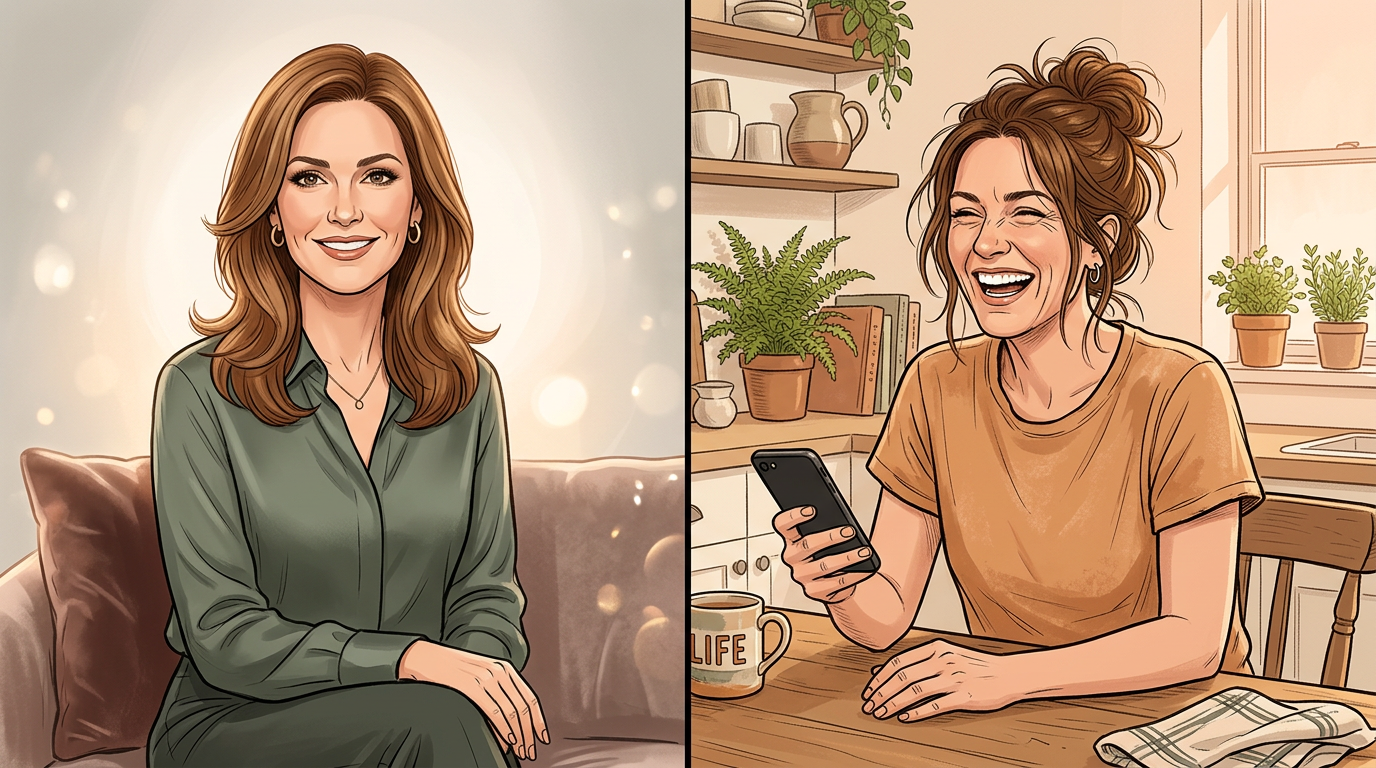
One of the more interesting things that emerged in the thread was how many people tested the opposite theory and found it worked. Lee Ann shared that she chose what she thought was her lamest photo, "no makeup, Mona Lisa smile in a tee shirt, and it was the one that got the most responses." Laura posted with the caption "I woke up like this. If you can't handle me at my worst, you can't have me at my best." Both were flooded with positive reactions. The thread rewarded authenticity in real time, right in front of everyone.
That is not a coincidence. The people who saw those photos and responded well had already told you something important about themselves. They are interested in a real person, not a highlight reel.
Laurie
There is a deeper layer here that I want to name gently, because I see it all the time and it deserves some honesty. A lot of people in this community spent years measuring their worthiness against a very specific standard. Appearance, behavior, spiritual performance. The idea that you might just show up as you actually are, without curating yourself for approval first, can feel genuinely threatening. Not careless. Threatening.
So when someone posts a photo where they look tired or ordinary or human, and 300 people respond with warmth and laughter and their own imperfect photos, that is not just a fun thread. That is a little experiment in what it feels like to be accepted without performing. Notice how good that felt. That is not an accident. That is your nervous system getting a tiny preview of what authentic connection actually offers. The goal on a dating app is not to get the most matches. It is to attract the right kind of attention from people who are interested in the real version of you. A great glamour shot is very good at the wrong job.
The Wave Emoji Is a Gift
Scott
I understand the frustration. You spent real time on your profile. You wrote something thoughtful. And they sent you a little waving hand.
One commenter in the thread put it plainly: "You liked me, I matched back, say something. I want to find out if you're literate." That is a fair request. And the frustration behind it is real.
But here is the reframe: low-effort outreach is information. It tells you, clearly and immediately, how much energy this person currently has for connection. You do not have to get angry about it or craft a brilliant response designed to spark them to life. You can simply note what you observed and move on. A wave emoji after a match is the equivalent of showing up to a first date and immediately checking your phone. You would not spend three months trying to build something with that person. You would wish them well and go find someone who was actually present.
The apps are exhausting partly because people treat every low-effort signal as a problem to be solved rather than a filter working exactly as designed. Let it filter. The goal is not to convert the uncommitted. The goal is to find the people who are already bringing effort to the table.
Feeling "On the Clock" Is the Real Issue
Scott
The original poster described getting excited about a match and then immediately feeling like the Jeopardy theme was playing in his head. He worried whether to reach out first, whether she might say something, whether he was moving too fast or not fast enough. He felt like he was on a clock.
That feeling is worth looking at directly, because it does not come from the app. It comes from the idea that a match is a precious, fragile thing that could slip away at any moment if you do not handle it perfectly. That framing puts you in a reactive, anxious posture before you have even typed a single word.
Interestingly, one commenter pushed back hard on the advice to wait two days before reaching out. She said: "Don't wait two days to reach out, that's annoying. My brain already decided you weren't interested. I processed, grieved, and moved on. That cycle is so obnoxious. Just say what you want, when you want." She is not wrong. But notice what she is actually describing: an anxiety response from her side that mirrors the one from his side. He is terrified of saying the wrong thing. She is already halfway out the door because he has not said anything yet. Both of them are operating from scarcity, just in different directions.
The answer is not better timing strategy. It is a more grounded starting point.
Laurie
What Scott is describing has a clinical name. It is called anxious activation, which just means your nervous system kicks into high gear when something feels uncertain or at risk. The intermittent nature of apps, the unpredictable responses, the ghosting, all of it is specifically the kind of environment that tends to amplify anxious patterns. And for people whose sense of worth got quietly tangled up with whether someone chose them, the app environment can feel like being sixteen again in the worst possible way.
The antidote is not a better strategy for when to send the first message. The antidote is getting your sense of self grounded somewhere that does not depend on whether a stranger responds. When you genuinely believe that a non-response does not mean anything about your value as a person, the clock disappears. You reach out when it feels right. You say something genuine. If they reply, great. If they do not, you move on without it costing you anything significant. That is not detachment. That is self-respect.
The Apps vs. In-Person Debate Is a False Choice
Scott
A significant portion of the thread was people declaring they had deleted the apps and would only meet people organically. But then Robyn raised something that did not get enough credit. She lives in a rural area and wrote: "There aren't many opportunities to meet people in everyday life, so this felt like one of the only options. It feels unnatural, a little exhausting at times, and not quite how I picture genuine connection happening." That is not a complaint. That is a geographic reality that a lot of people in this community live with every day.
Amy summed it up well: "Apps make a lot of loud noise in our heads and dopamine hits to our bodies." She is right. But for some people, the noise is still worth it because the alternative is silence.
The most grounding story in the whole thread came from a woman who said she had been on apps for years getting mostly one-word openers, until someone actually called her instead of texting. They had not stopped talking since. They had flown to meet each other. They were getting married in July. Her takeaway: "If you want to date somebody, you actually have to talk to them." She met him on an app. The app was not the point. The conversation was the point.
Delete the apps if they are making you feel worse about yourself every time you open them. Keep them if they are occasionally connecting you with people you would never otherwise meet. The question is not which tool you use. The question is who you are while you are using it.
You Are Allowed to Want More Than This
Laurie
One comment has stayed with me since I first read the thread. Someone said she had stopped using apps before because the experience was "detrimental to my ego," and that before she could try again she would need to psych herself up, keep reminding herself she was good enough, smart enough, and that people liked her. She quoted a famous comedy sketch to make the point, which was funny. But underneath the humor was something true and a little tender, and I do not want to skip past it.
If getting on a dating app requires a pep talk first, that is information worth sitting with. Not because apps are bad or because you are broken, but because it means you are carrying something into the experience that the experience keeps activating. That is not an app problem. That is an internal one. And it is very fixable.
The reason so many people in that thread keep going back, even when they hate it, is not weakness or foolishness. It is hope. Something in them still believes that real connection is possible. That is worth protecting. Not the apps, not any particular strategy. The hope itself.
That hope is correct. The connection you are looking for is real, and it is available to you. The work is less about finding the right app or the right opening line and more about becoming the kind of person who can recognize a good thing when it arrives, and who trusts themselves enough to show up honestly when it does.
The glamour shot version of you will never get there. The real version of you has an excellent chance.
And when you are ready to go deeper, we will be here.
— Scott & Laurie
Weighing in from the lowest tier of the Celestial Kingdom, where we finally realized the Jeopardy theme only plays if you let it.